02 Process

PlantPulse Platform

Industrial data infrastructure that runs the moment you install it

An enterprise IIoT/DataOps platform that delivers the full data lifecycle — ingestion, messaging, storage, processing, analytics, and visualization — in a single installable package. With an ontology knowledge graph, a Unified Namespace, 100+ no-code Flow nodes, and complex event processing (CEP), 24+ pre-integrated microservices across 7 layers replace the patchwork of SCADA, historians, gateways, and databases with one platform.

Key Metric

40,000/s

Message ingestion throughput

A Capabilities · In depth

01

Industry-leading ingestion and processing performance

A single server node ingests 40,000 sensor messages per second, and the in-memory complex event processing (CEP) engine evaluates 500,000 events per second in real time. EQL (Event Query Language) time windows judge rules, patterns, and advanced alarms instantly, rolling up aggregates, snapshots, and predictions.

  • 40,000 messages/sec ingestion · 500,000 events/sec CEP
  • EQL time-window stream analytics + 4 asset domain rules
  • Full roll-up from measurement to machine-context data
Industry-leading ingestion and processing performance
02

The world's most modern industrial data lake

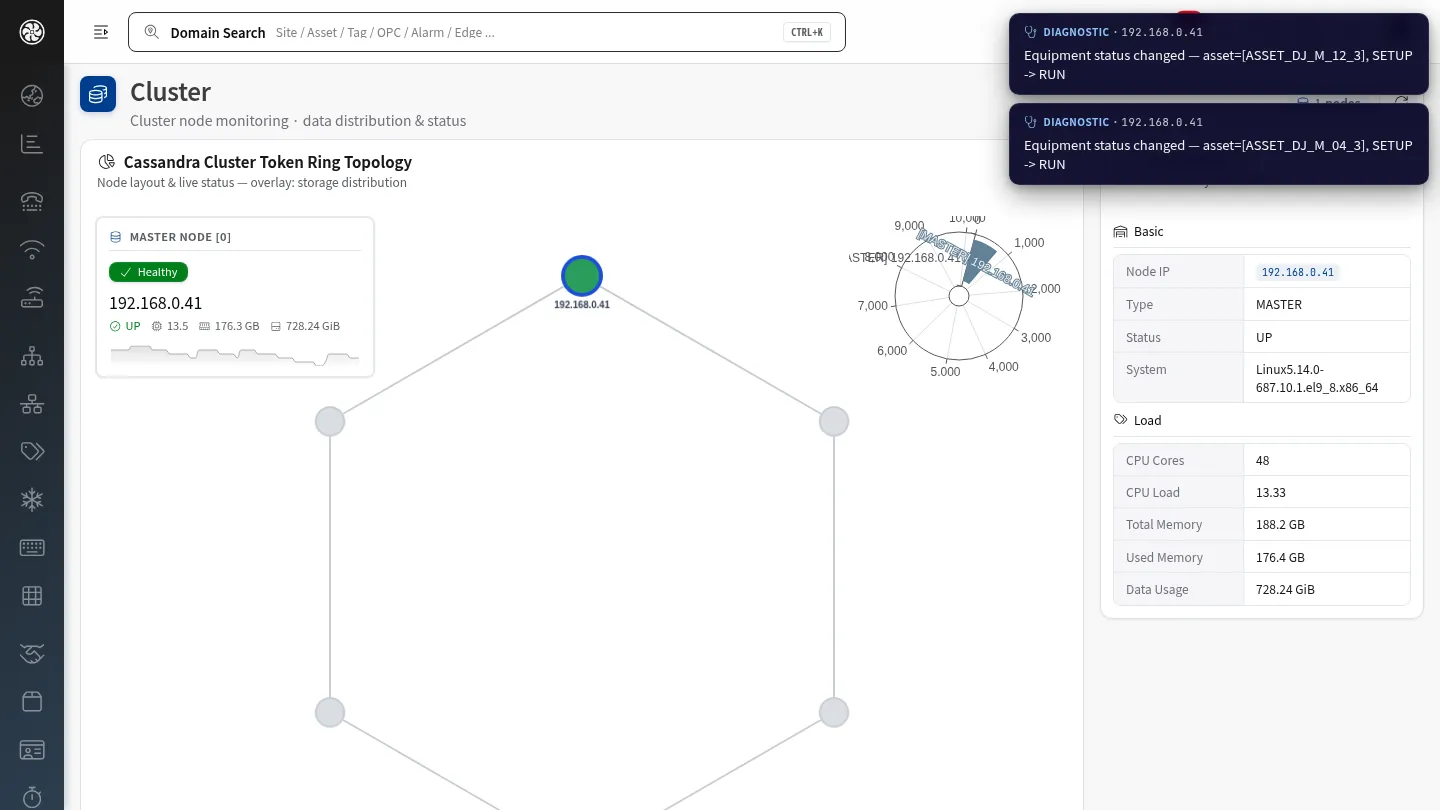
Built on the same class of distributed event and time-series database used by global hyperscalers, tuned for industrial data. A token-ring architecture automatically distributes data across nodes, so capacity scales linearly just by adding nodes — and replication means no data is lost when a node fails. Billions of time-series points and events, plus BLOB objects like drawings and images, live in a single cluster, with ring topology, node load, and storage distribution monitored live from the console.

  • Token-ring distributed architecture — linear scale-out by adding nodes
  • Billions of time-series points, events, and BLOB objects in one cluster
  • Live console for ring topology, node health, and storage distribution
The world's most modern industrial data lake
03

Ontology — your plant as a living knowledge graph

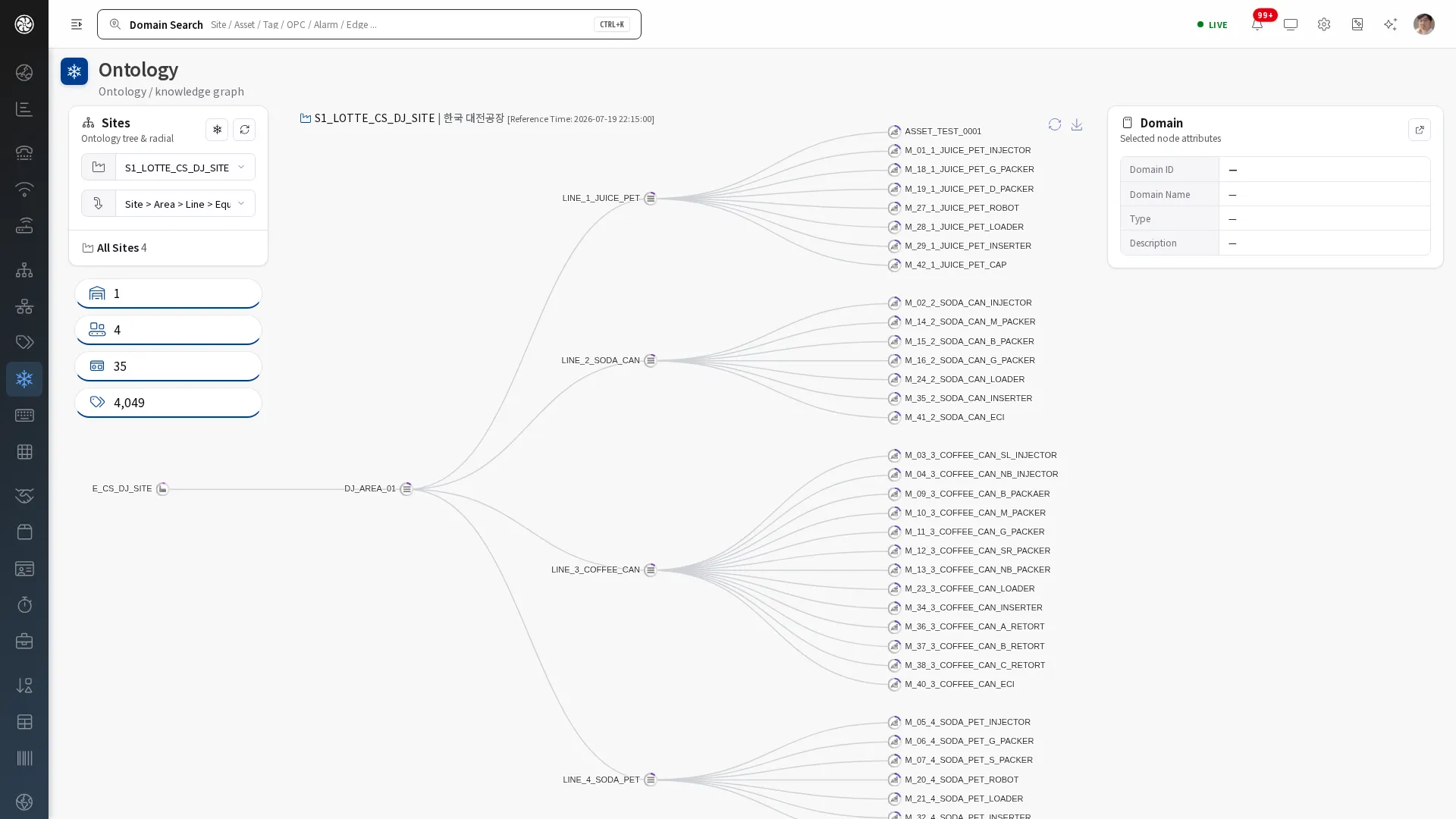
Beyond simple asset classification, turn the whole plant into an RDF knowledge graph. On top of the ISA-95 hierarchy, link feeds/depends-on/produces relationships and command, document, and alarm-config registries as triples — so complex questions like "setpoint tags missing alarm config" or "the downstream impact of a failed asset" are answered instantly with SPARQL and a relation-graph API. Built-in AI performs natural-language diagnosis grounded in this ontology.

  • RDF knowledge graph + read-only SPARQL (SELECT/ASK)
  • Feeds/depends-on/produces relations + impact-propagation graph (BFS)
  • A semantic layer beyond ISA-95 — people and AI share the same context
Ontology — your plant as a living knowledge graph
04

Unified Namespace — the asset hierarchy is your live address space

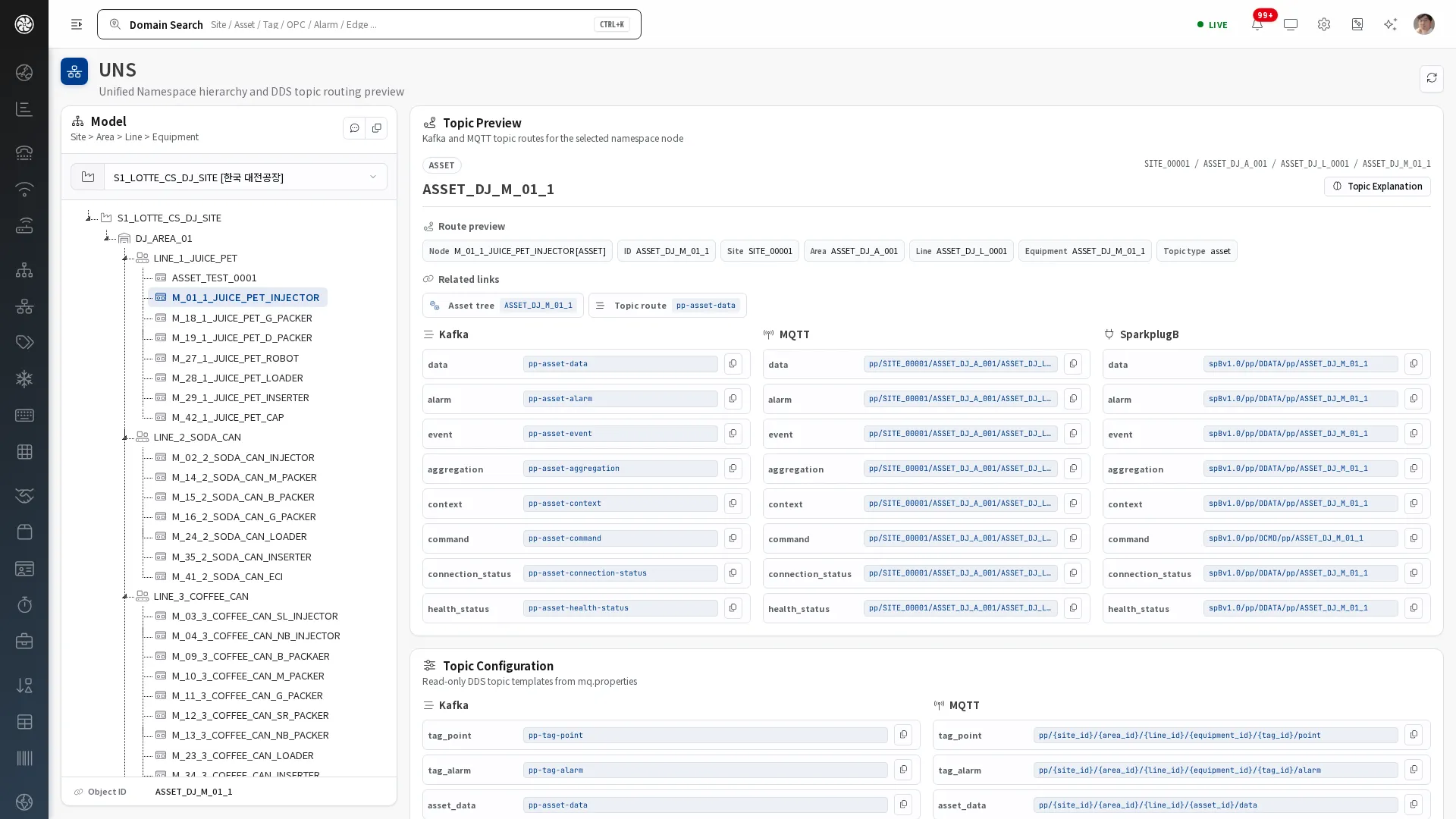
The ISA-95 tree (site→area→line→equipment→tag) itself becomes a single namespace for live data. Every node maps automatically to three industrial-standard topics — MQTT, a messaging broker, and Sparkplug B — and data, alarms, events, aggregations, commands, plus connection and health status are mirrored in real time. Preview topic paths in the console and paste them straight into external systems or flows.

  • Auto-generated MQTT · broker · Sparkplug B unified topics
  • Real-time asset-state mirroring including connection and health
  • Vendor-scattered comms unified into one standard namespace
Unified Namespace — the asset hierarchy is your live address space
05

Flow — industrial data automation without code

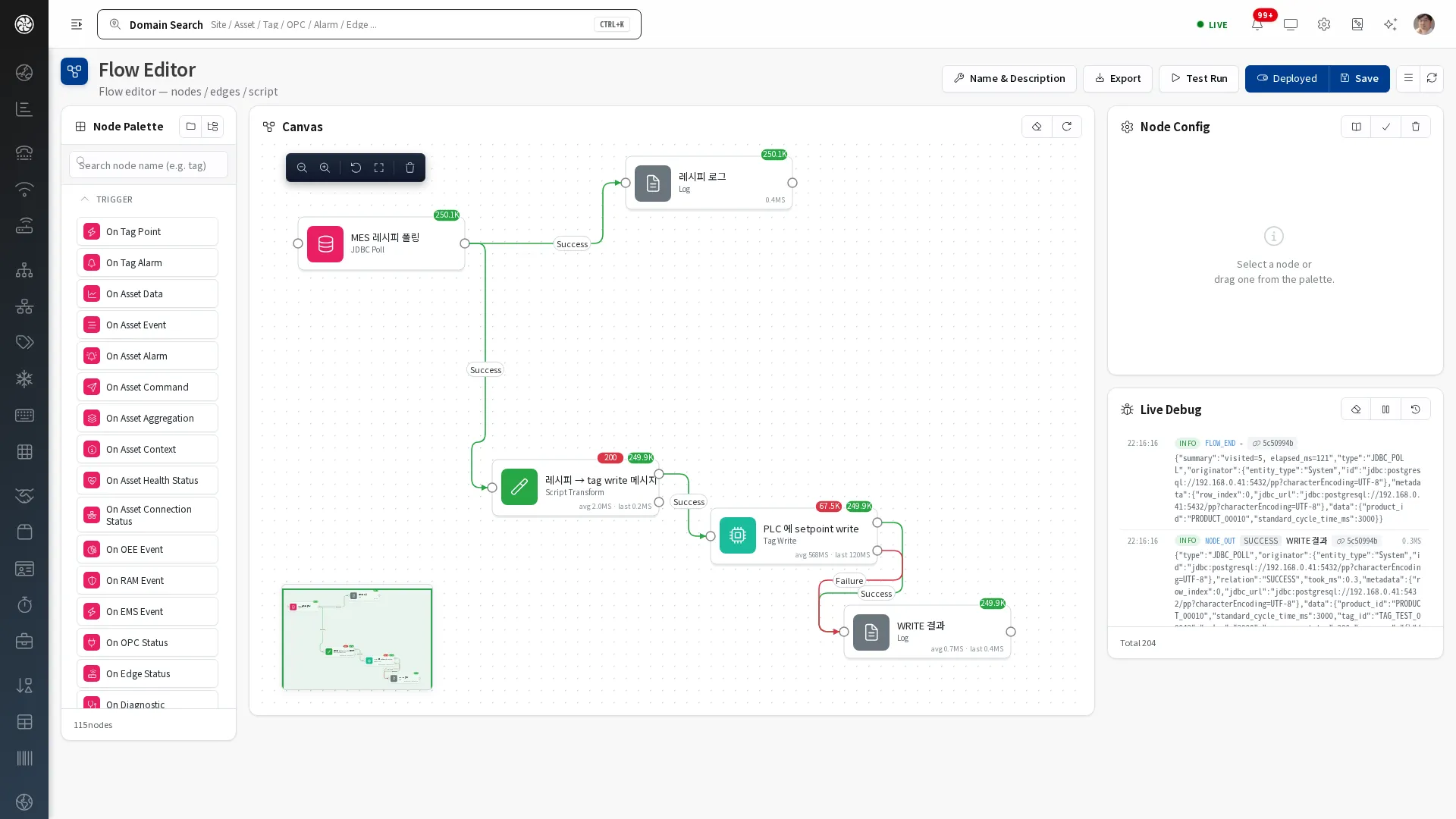
A visual automation engine that designs industrial data pipelines by dragging and connecting 100+ nodes. Trigger on tags, alarms, asset events, OEE, or edge status, then filter, script, aggregate, and retry — issuing work orders, sending email/SMS/push alerts, integrating with external MES/ERP, and controlling the edge, all on one canvas. Deploy, roll back, version automatically, and live-debug so operators build and safely ship automation themselves.

  • 100+ nodes · triggers/filters/transforms/actions/integrations/flow-control
  • Work orders, alerts, MES/ERP integration, edge control — no code
  • Deploy/rollback · automatic snapshot versioning · live debug
Flow — industrial data automation without code

B Architecture

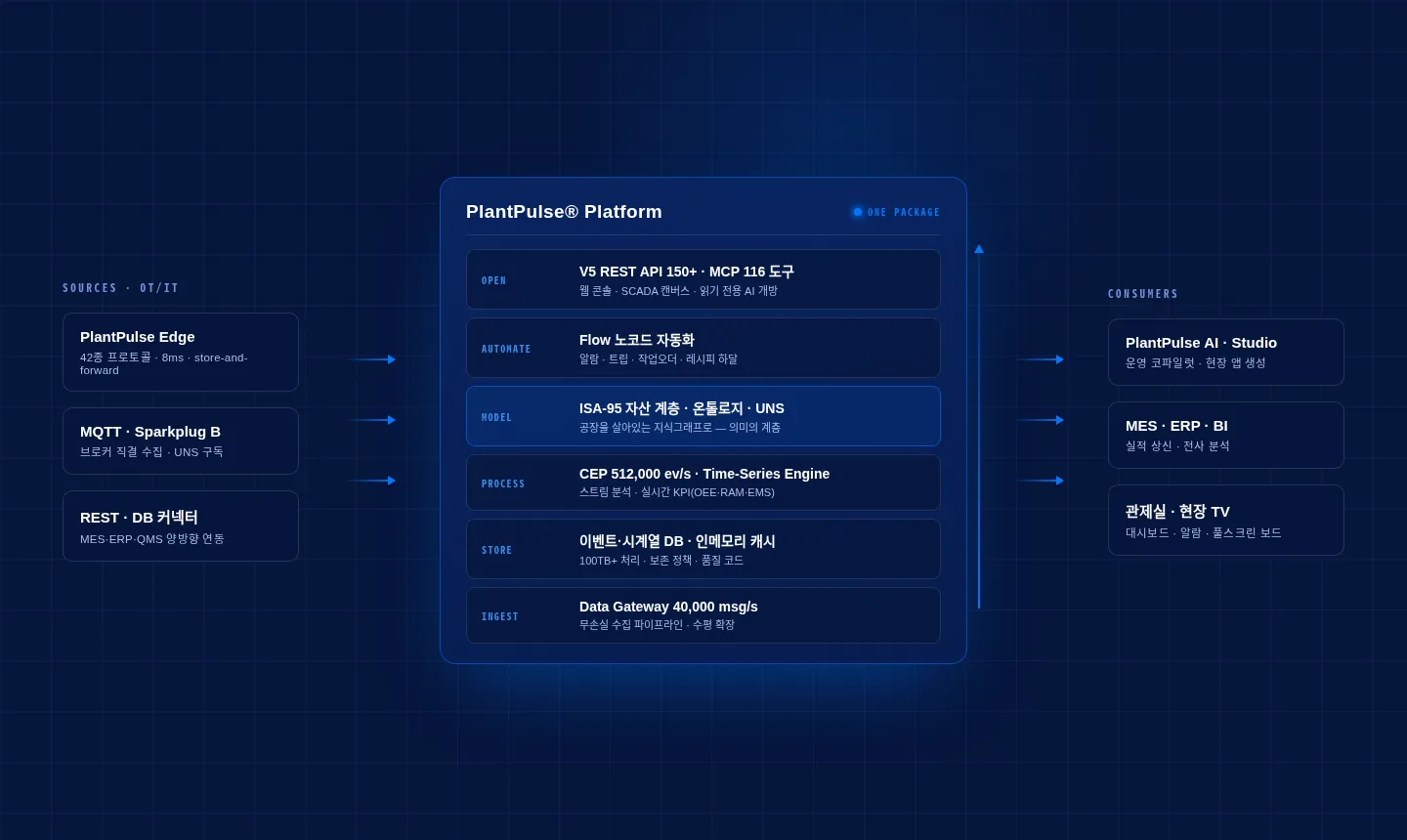
PlantPulse Platform architecture — one package flowing from OT/IT sources through six layers (ingest, store, process, model, automate, open) to AI, MES, and control rooms

Seven layers from ingestion to console come pre-integrated as one package, booting the entire pipeline within 3–5 minutes. Ontology, UNS, Flow, and CEP all operate on one data foundation.

C Use Cases

Food & Chemicals
Challenge
Multi-vendor SCADA, historians, and databases are scattered, making integration hard and costly.
Solution
Unify ingestion, storage, analytics, and console on one platform and standardize data with ontology.

Outcome

Many products → one platform · simplified operations

Power (Wind & Solar)
Challenge
It's hard to see the real-time status of distributed plants in one place.
Solution
Monitor all plants through a site hierarchy and standard UNS topics.

Outcome

Real-time unified visibility of distributed assets

Process Plants
Challenge
Large equipment issues are caught only by rule-based alarms, so response is late.
Solution
Connect detection to action with CEP advanced alarms and Flow automation.

Outcome

Early anomaly detection · automated response

E More Capabilities

01

Ontology knowledge graph

Standardize relationships among equipment, tags, and documents with an RDF graph and SPARQL, and analyze impact propagation.

02

Unified Namespace

Mirror the asset hierarchy in real time across a unified MQTT · broker · Sparkplug B namespace.

03

No-code Flow

Compose data pipelines, automation, and external integrations with 100+ nodes — no code.

04

CEP at 500,000 events/sec

An in-memory CEP engine evaluates rules, patterns, and advanced alarms with EQL time windows in real time.

05

Web SCADA canvas

Place real-time widgets on diagrams, full-screen floor displays, and band/CEP advanced alarms.

06

Data gateway · V5 API

A gateway for external BI/ERP to query time-series safely, plus 150+ V5 REST APIs.

07

ISO 22400 analytics · auto diagnosis

Compute OEE, RAM (MTBF/MTTR), and EMS (energy/CO₂), with a 10-year diagnostic engine detecting faults automatically.

08

ISA-95 · MES · multi-site

International-standard asset hierarchy, work-order/production management, and multi-site HA with infinite scale-out.

09

Factory model — logical·physical mapping

Put the logical model and the physical equipment tree side by side and map them. An asset timeline tracks configuration changes.

10

Equipment card monitoring

Monitor equipment as a card grid filtered by area and line, with five status lights to identify run, stop, and fault at a glance.

11

Production master data

Manage production master data — customers, products, staff, shift schedules, and work orders — inside the platform.

12

Alarm center & advanced search

Survey all alarms with timelines, statistics, and rankings, then narrow the cause quickly with asset-tree-based advanced search.

13

Live stream & trends

Stream tags to real-time charts, and query accumulated history by period and condition on the trend screen.

14

Daily statistics & self-metrics

A yearly availability heatmap, KPI and latency trends, six-panel infrastructure health, and a connection heatmap — the platform measures itself.

F Technical Specifications

Ingestion
40,000 msg/s · 10+ protocols (OPC-DA/UA, Modbus, MQTT…)
Processing · automation
CEP 500,000 ev/s (EQL) · no-code Flow with 100+ nodes
Semantic
Ontology RDF/SPARQL · Unified Namespace (MQTT·broker·Sparkplug B)
Storage
Event/time-series DB · relational meta · graph DB · object store · in-memory cache
Analytics
Distributed analytics engine · proprietary Time-Series Engine · data gateway
API · standards · security
150+ V5 REST APIs · ISA-95 · OPC-UA · end-to-end TLS · RBAC
Architecture
7 layers, 24+ microservices · boots in 3–5 min · multi-site HA

G Product Screens

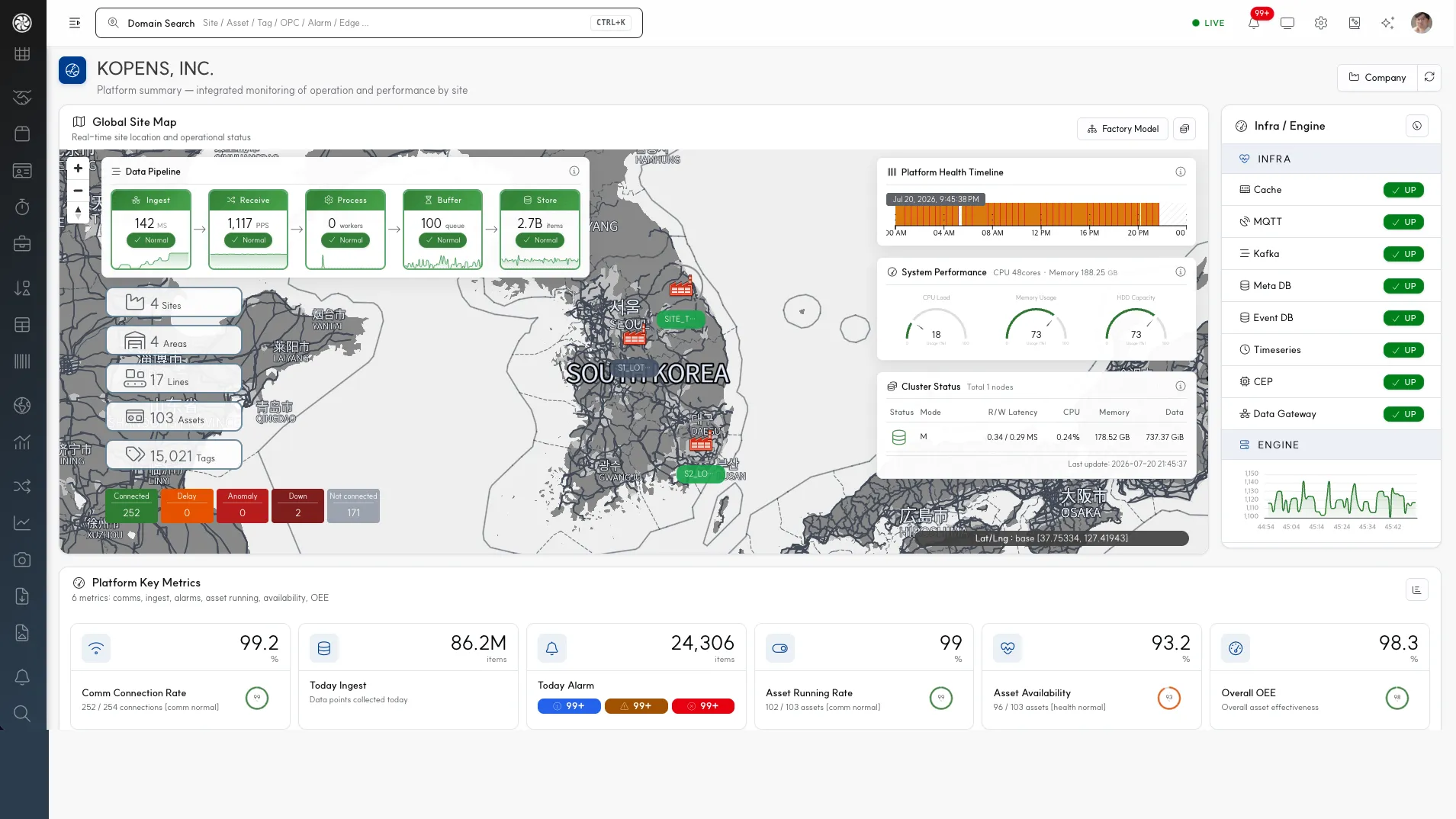
PlantPulse Platform — Industrial data infrastructure that runs the moment you install it

D FAQ

How is the ontology different from a normal asset tree?

It goes beyond a hierarchy to an RDF knowledge graph that also expresses feeds/depends-on/produces relationships. You query complex conditions with SPARQL, explore the downstream impact of a failure with the relation-graph API, and the AI performs natural-language diagnosis grounded in it.

Do you support a Unified Namespace?

Yes. We provide a UNS that auto-maps the ISA-95 asset hierarchy to three standard topics — MQTT, a messaging broker, and Sparkplug B. Data, alarms, and status are mirrored in real time, and you can preview topic paths in the console and connect them straight to external systems.

Can I build automation without code?

The no-code Flow engine lets you drag and drop 100+ nodes to compose triggers, filters, transforms, actions, and integrations — issuing work orders, alerts, MES/ERP integration, and edge control without code, operated safely with versioning and rollback.

How far does it scale?

A single server node ingests 40,000 messages per second, and adding cluster nodes scales it out without limit. Multi-site HA runs large multi-site environments on one platform.

How do external systems and apps integrate?

Over 150 V5 REST APIs, real-time push APIs, and a data gateway that lets external BI/ERP query time-series safely (no direct DB access, with permissions and audit).

See it live on real operating screens

A 30-minute demo walks you from ingest to AI. Check the fit for your plant with an expert, right away.