
Solution
AI Manufacturing Data Management
Standardize scattered manufacturing data with a standard asset model (ISA-95) and an ontology knowledge graph so people and AI share the same context — a trusted data foundation. AI accesses operational context safely on top of it via read-only MCP.
Manufacturing AI succeeds or fails on the data foundation, not the model. An AI that doesn't know which line, which machine, and which signal 'TAG_00042' refers to cannot answer anything. The ontology builds that context, the UNS delivers it in real time, and MCP opens it safely.
A Challenges we solve
Data silos and missing context
Opening data to AI safely
An unstandardized sea of tags
Every team defining data differently
B Key capabilities
Ontology & semantic layer
Standardize relationships among equipment, tags, and documents with an RDF knowledge graph and SPARQL — the graph answers what an asset connects to and what it affects.
Unified Namespace
Mirror the asset hierarchy onto standard MQTT·Sparkplug B topics in real time, so every system subscribes through one address space.
Safe AI access
Open operational context to AI via read-only MCP tools without exposing control paths. AI can query — it can never touch equipment.
Standard asset model
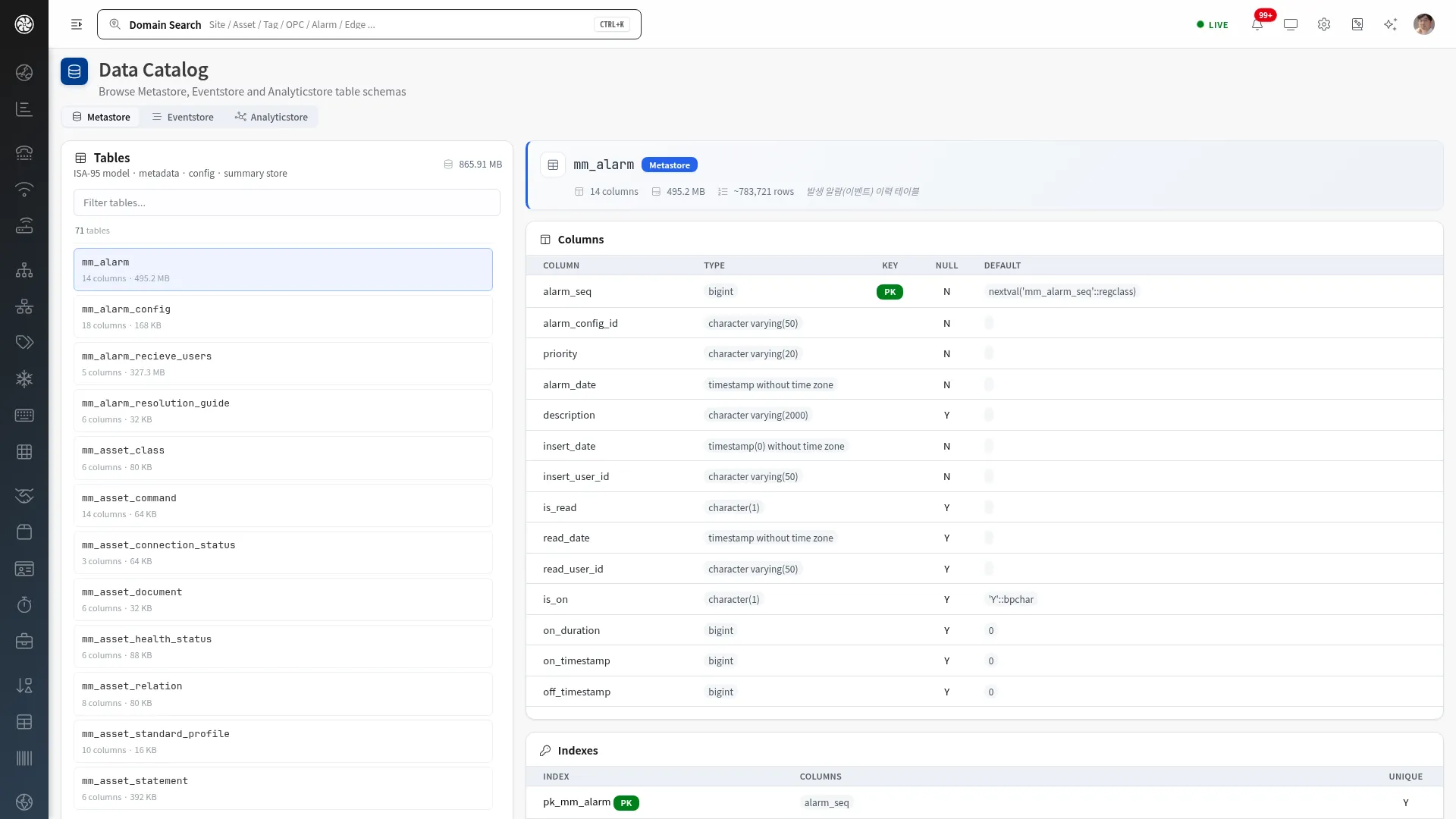
Organize tags into the ISA-95 site–area–line–equipment hierarchy, unifying definitions that used to differ by team.
Unified time-series & event store
Store and query sensor streams and events together on a high-throughput ingestion pipeline and event/time-series database.
On-premises AI
Run an industrial LLM inside the plant so data never leaves the site — AI with data sovereignty intact.
C How it works
Collect & standardize
Ingest equipment data over 42 protocols and organize it into the standard asset hierarchy.
Model the ontology
Model relationships among equipment, tags, documents, and events as an RDF knowledge graph.
Open the UNS
Mirror the asset hierarchy onto standard topics for enterprise-wide real-time subscription.
Put AI to work
AI copilots and agents diagnose and analyze on top of operational context via read-only MCP tools.
116
read-only MCP tools
150+
V5 REST APIs
642,021
connected sensors (cumulative)
100TB+
data processed
D Where it applies
Standardize ~4,000 plant tags into the ontology; an AI copilot diagnoses equipment anomalies on top of it.
A 10-second diagnosis from one question
Unify tag naming that drifted with every line expansion into one standard asset model, cutting analysis lead time.
Tag standardization · less prep time
Link equipment sensors with maintenance history and documents in the knowledge graph to summon context instantly on failures.
Context-driven root-cause analysis
C Outcomes
- AI-ready data foundation
- Semantic data usage
- Data sovereignty retained
D Related products
D FAQ
Could the AI end up controlling equipment?
No. AI is only given read-only MCP tools; control paths are never exposed. Actions that require control go through a separate path gated by human approval.
Doesn't building an ontology take forever?
You start from the ISA-95 standard hierarchy and asset-tree import, so there's no need for a perfect graph up front. Model the critical equipment first and grow relationships as you operate.
Is the cloud required?
No. Both the platform and the industrial LLM run fully on-premises — suitable even for defense and secure-process environments where data must never leave the site.
See it live on real operating screens
A 30-minute demo walks you from ingest to AI. Check the fit for your plant with an expert, right away.