03 Intelligence

PlantPulse AI

All your plant data, for everyone, in one sentence

A plant AI operations copilot that runs on top of the IIoT platform. Beyond a chatbot, it drafts prioritized task suggestions every morning, detects anomalies and proposes root causes and actions, and — for any natural-language question — orchestrates live queries, forecasting, and manual search to return a full report in 10 seconds. With a proprietary industrial LLM (AURA) deployed on-premises, your data never leaves the plant.

Key Metric

10 sec

NL query to full report

A Capabilities · In depth

01

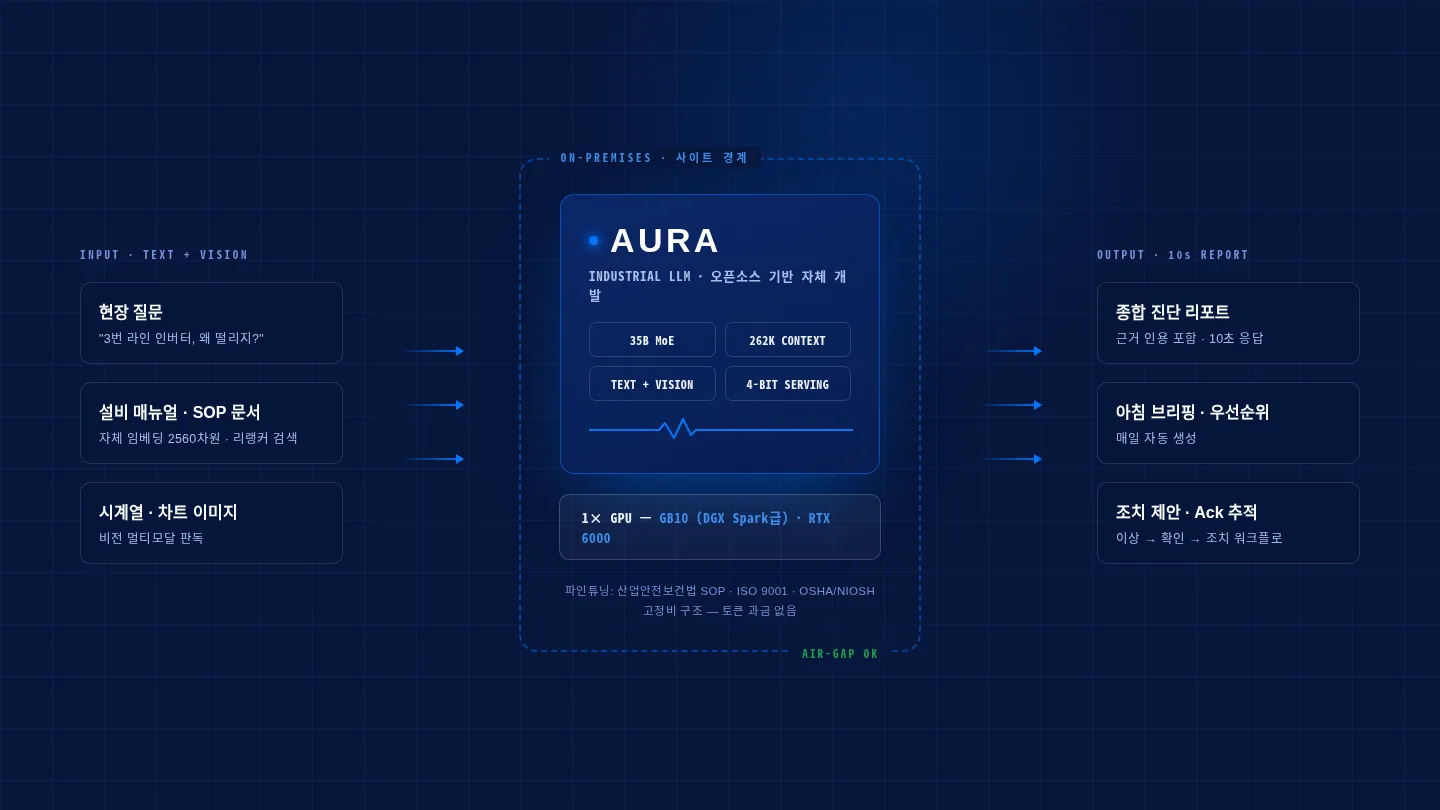
AURA — an industrial LLM that runs inside the plant

The brain of PlantPulse AI is AURA, an industrial LLM we developed in-house on open-source foundations. A 35B MoE architecture with a 262K long context and vision-capable multimodality reads equipment manuals and chart images alike. It is fine-tuned on industrial standards — occupational-safety SOPs, ISO 9001 quality procedures, OSHA/NIOSH safety practices — and runs on-premises on a single GPU such as GB10 (DGX Spark-class) or RTX 6000.

  • In-house LLM on open-source foundations — 35B MoE · 262K context · vision-capable multimodal
  • Runs on one GPU — GB10 (DGX Spark-class) · RTX 6000, 4-bit quantized, on-premises
  • Fine-tuned on industrial standards — occupational-safety SOPs, ISO 9001, OSHA/NIOSH
  • Korean-native, fluent in field terms like degradation, interlock, and trip
  • Fixed cost (no per-token billing) · proprietary embeddings (2560-dim) and reranker
AURA — an industrial LLM that runs inside the plant
02

One question, a full diagnosis in 10 seconds

Ask "analyze the injector" and the built-in AI agent decides for itself to query live sensors, run anomaly detection and forecasting, map equipment relationships, and search manuals — then combines it all into one report. The analysis streams in real time, and results are visualized as tables, charts, and diagrams. Multimodal questions with attached images are supported.

  • The built-in agent auto-selects and chains tools (tool-calling)
  • Situation awareness: 30–60 min → 10 sec (estimate)
  • Rich tables · charts · diagrams + real-time streaming
One question, a full diagnosis in 10 seconds
03

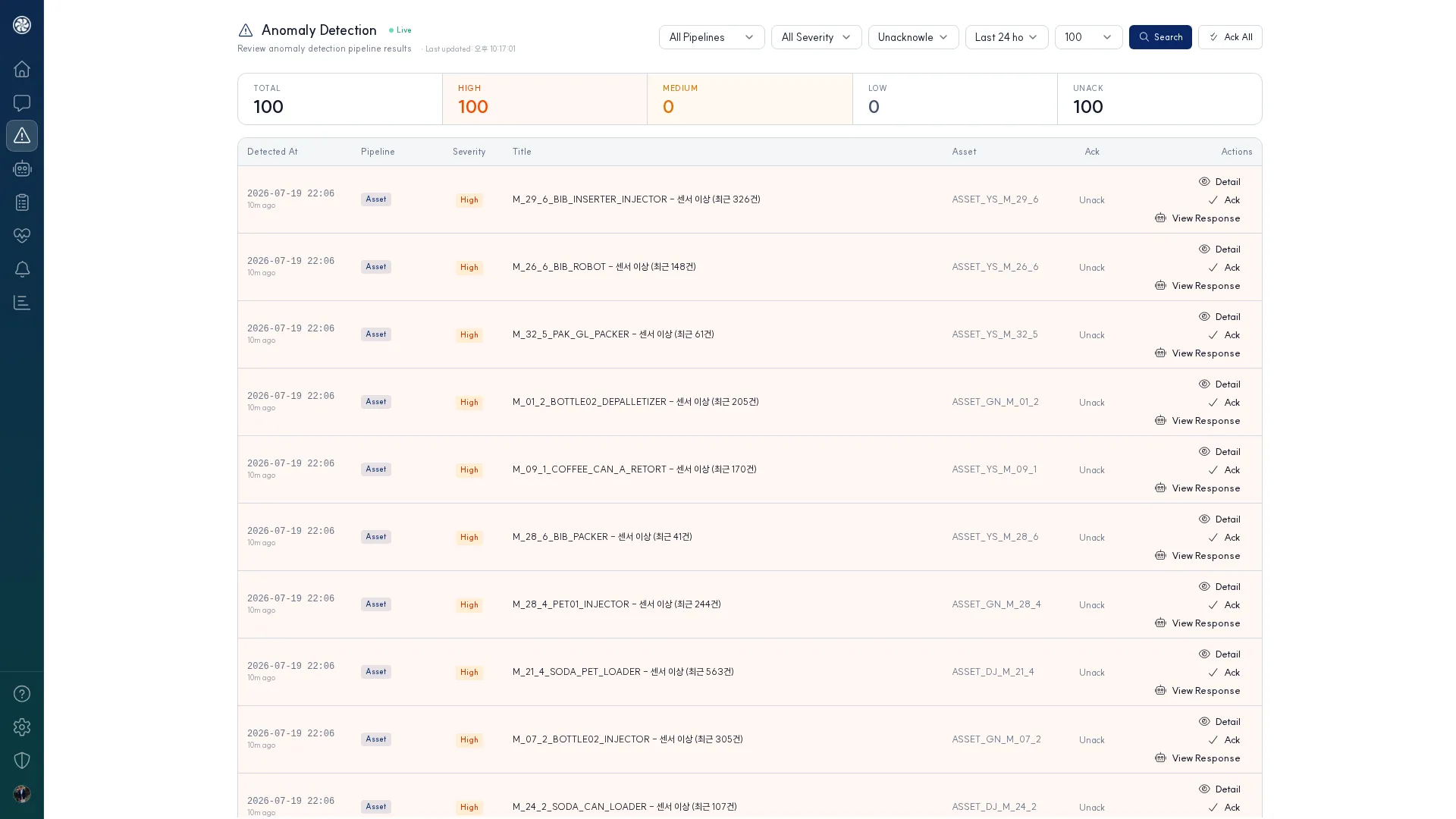
From anomaly to action, so nothing slips through

Hourly automatic anomaly detection and real-time alarms are promoted into a single incident, and the AI diagnoses the cause and generates recommended actions automatically. Incidents are tracked through acknowledgment and closure, with duplicates deduplicated. Alerts reach the right person over three channels.

  • Equipment · production · energy anomalies unified as incidents
  • AI root-cause diagnosis + auto-generated actions
  • In-app · email · messenger — 3 alert channels
From anomaly to action, so nothing slips through
04

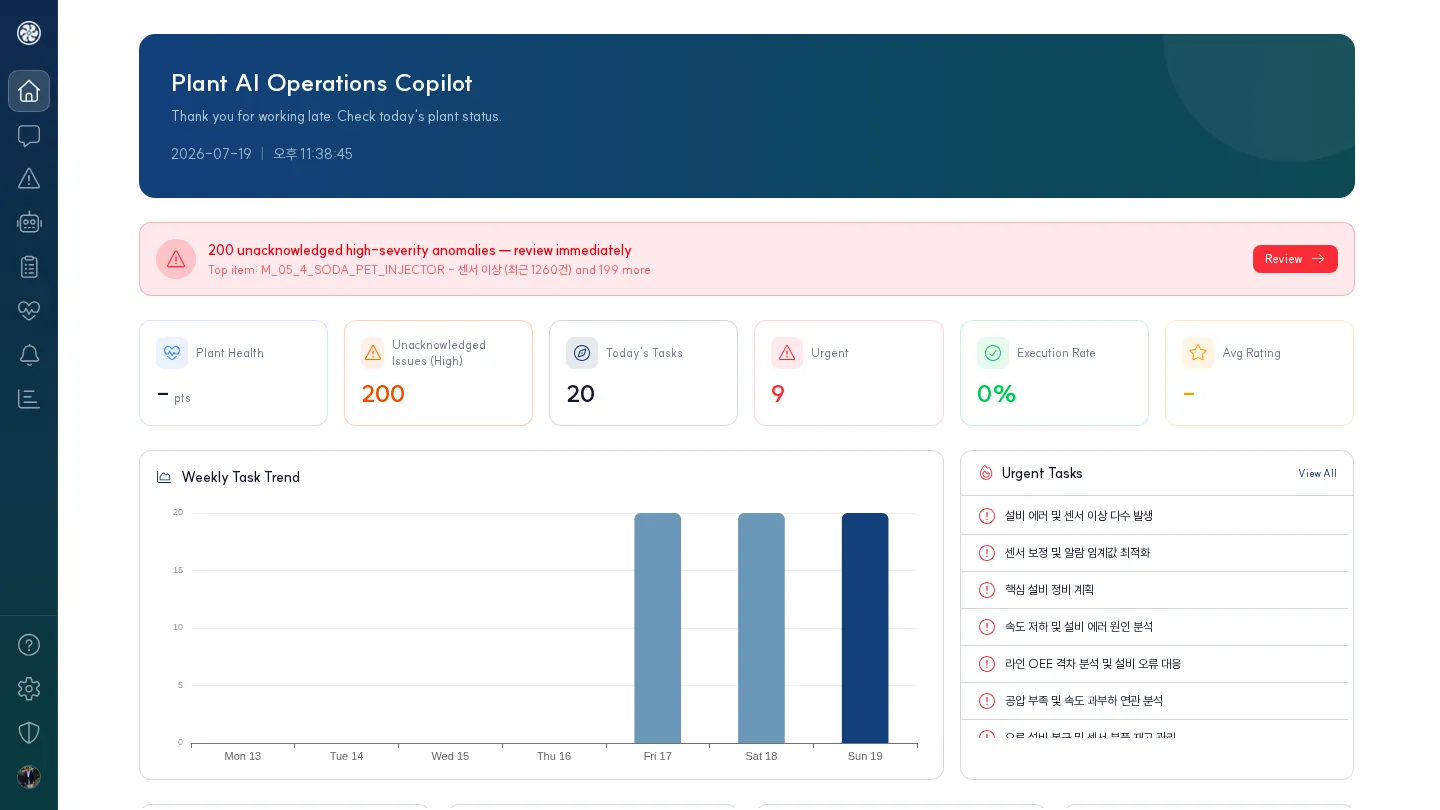
Every morning, an AI-drafted to-do list

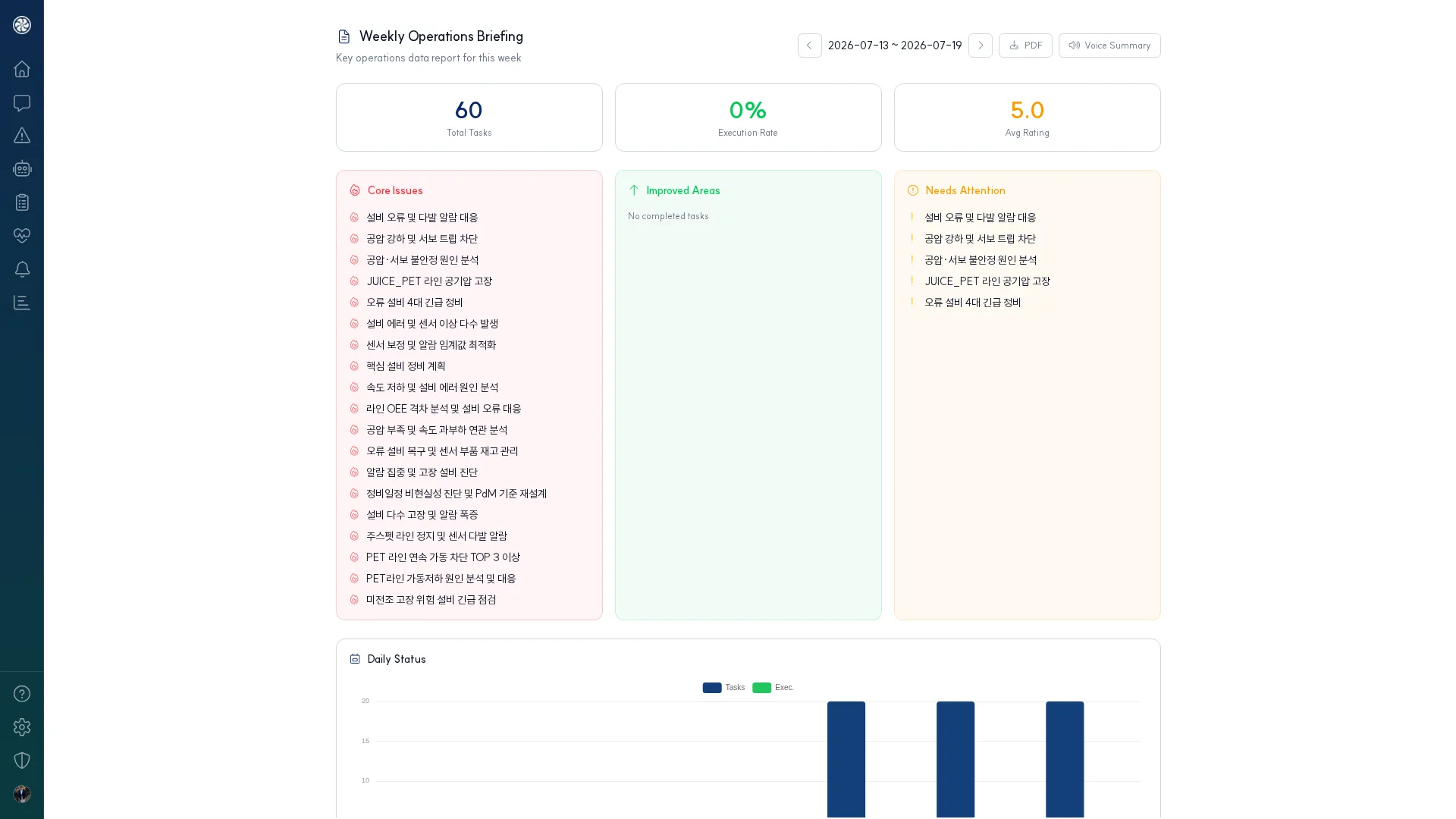
The AI analyzes plant status daily and automatically drafts prioritized task suggestions assigned to the right people. Weekly briefings, next-day forecasts, and correlation analysis across suggestions help even non-experts see what to look at first.

  • Daily prioritized task suggestions (20 by default)
  • Owner assignment · PDF export · watchlist auto-tracking
  • Weekly briefing · next-day forecast · correlation analysis
Every morning, an AI-drafted to-do list
05

Time-series insight server — a dedicated detection & forecasting engine

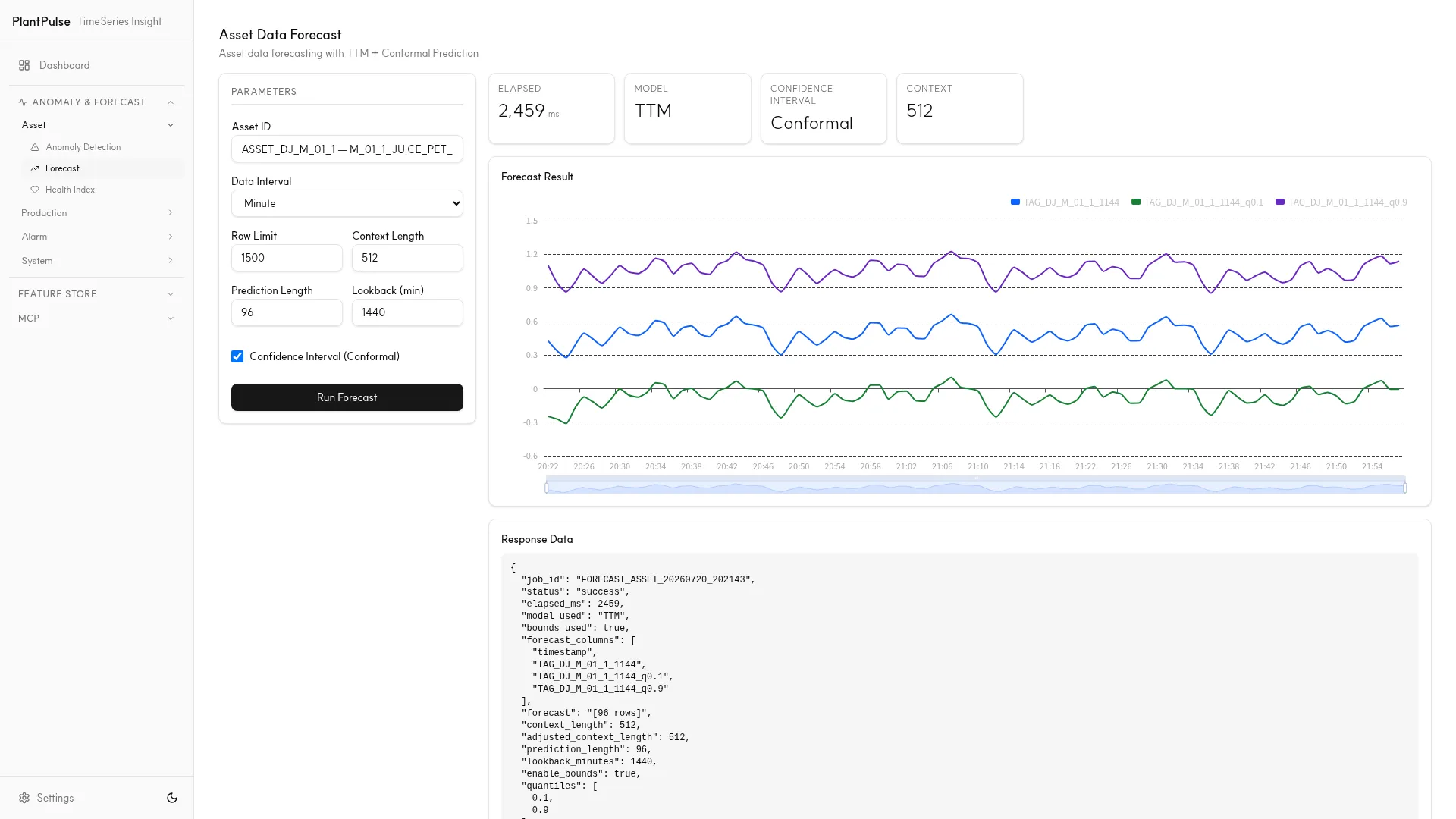
Time-series analytics run on a dedicated insight server. Industrial time-series foundation models are served on your own GPUs (with automatic CPU fallback), covering anomaly detection across 9 domains and forecasting across 8 — sensors, OEE, energy, alarms, and work orders. Anomaly scores combine time- and frequency-domain reconstruction, and forecasts ship with conformal-prediction confidence bands. A feature store auto-builds hourly and daily features per tag and asset to power similar-asset search and LLM context, while five alarm diagnostics — frequency, duration, sensor correlation, failure prediction, and statistics — narrow down root causes.

  • 9 anomaly-detection domains · 8 forecasting domains — sensors, OEE, energy, alarms, work orders
  • Time + frequency reconstruction scoring · conformal confidence bands · automatic fallback
  • Asset health score 0–100 — weighted across sensors, OEE, reliability, energy, alarms, graded A–D
  • Feature store — hourly/daily auto-features, similar-asset search, LLM context supply
  • Offline images with models built in — on-prem GPU inference with CPU fallback
Time-series insight server — a dedicated detection & forecasting engine
06

Plant-document RAG — grounded answers that stay current on their own

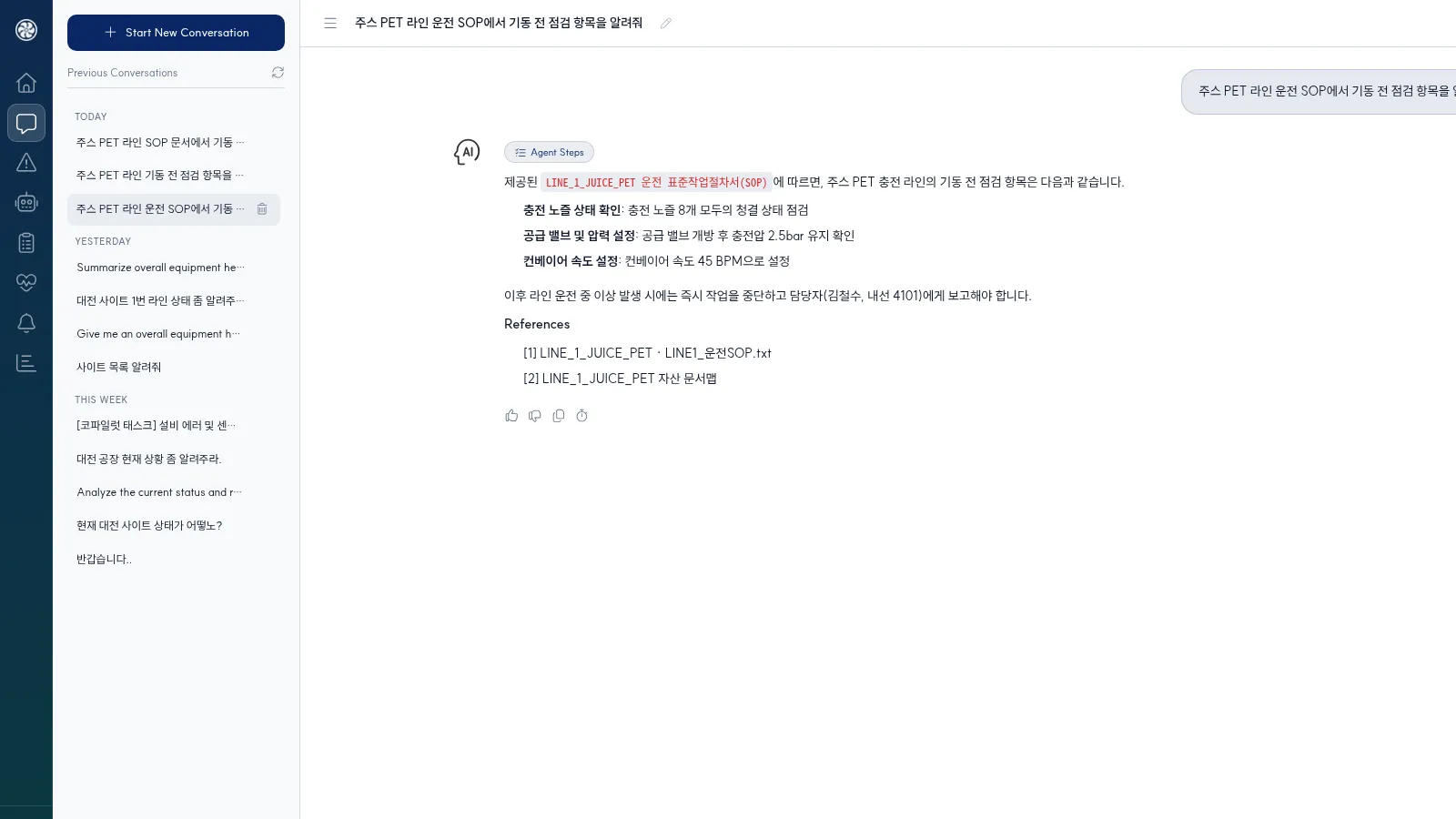
Asset documents like equipment manuals and SOPs are searched with knowledge-graph RAG. Four search modes combine vector search with entity and relation graphs to find evidence that matches the question, and every answer cites which document of which asset it came from. Documents registered on the platform are kept in sync by a 10-minute incremental indexing cycle that reconciles additions, changes, and deletions by itself — and the search engine is isolated on the internal network, so documents never leave your plant.

  • Vector + knowledge-graph hybrid — four search modes
  • Citations — answers arrive with 'asset · document' evidence
  • 10-minute incremental indexing — additions, changes, deletions auto-reconciled
  • Auto-indexes PDF · Word · PPT · Excel · MD · TXT · multilingual reranker
  • Search engine isolated on the internal network — documents never leave
Plant-document RAG — grounded answers that stay current on their own

B Architecture

Natural-language query

AI operations copilot

AURA LLM (on-prem)

Unified data tools

live & historical · 116

TimeSeries-Insight

anomaly & forecast · 27

Knowledge graph

asset relations · 14 nodes

Document search (RAG)

manuals · SOPs

Full report · 10 sec

One question flows through the built-in AI agent, which automatically combines 116 data tools, time-series analytics, a knowledge graph, and document search — and the on-premises AURA LLM generates a full report with citations.

C Use Cases

Chemicals & Petrochemicals
Challenge
Process anomalies are caught late by alarms, leaving only reactive response.
Solution
Hourly automatic detection plus AI root-cause diagnosis catch issues early, with safety-regulation context.

Outcome

30–50% less unplanned downtime (estimate)

Food & Beverage
Challenge
OEE, quality, and energy data are scattered per line, slowing situation awareness.
Solution
A single natural-language query pulls OEE, quality, and energy together into one report.

Outcome

90% faster situation awareness (estimate)

Semiconductor & Electronics
Challenge
Tracing subtle signal anomalies and yield drops depends on experts.
Solution
Forecasting, anomaly tools, and the knowledge graph trace causes and auto-suggest actions.

Outcome

Tribal knowledge captured · 40–60% faster handover (estimate)

E More Capabilities

01

Multimodal conversation

Ask with natural language and images; get answers as tables, charts, and diagrams. Watch the analysis stream in real time.

02

116 unified data tools

The AI automatically composes 116 tools covering every real-time and historical dataset on the platform — all read-only by design.

03

27 detection & forecast tools

Industrial time-series AI models provide 27 analysis tools spanning 9 anomaly-detection and 8 forecasting domains.

04

Knowledge graph

Equipment, tags, and documents linked in a 14-node-type graph give answers real context.

05

Document search (RAG)

Searches equipment manuals and SOPs, answering with citations. Four search modes supported.

06

On-premises deployment

The industrial LLM is served on your own GPUs. Sensitive process data never leaves your network.

F Technical Specifications

AI models
AURA LLM (proprietary, 35B MoE · 262K context · vision-capable) · industrial time-series anomaly/forecast models
Embedding · reranker
AURA embedding (2560-dim) · AURA reranker
Tool scale
116 unified data · 27 time-series analysis · 5 knowledge graph · 3 document search
Knowledge
Graph DB (14 node types) · vector DB · RAG 4 modes
Deployment
On-premises containers · low-spec GPU (DGX Spark-class) support
Expected impact
Downtime 30–50%↓ · OEE 3–8pp↑ · energy 5–15%↓ (estimate)

G Product Screens

PlantPulse AI — All your plant data, for everyone, in one sentence

D FAQ

Does data leave for the cloud?

No. It runs fully on-premises and works even in air-gapped environments with no internet. AURA LLM is served on your own GPUs, so process data never leaves your organization.

Will it affect our existing operational systems?

All 116 data tools are read-only by design. The AI only queries and analyzes — it never writes control values — so it doesn't interfere with existing operations.

What GPU do we need?

AURA uses an MoE architecture and 4-bit quantization to run a large model on low-spec GPUs (NVIDIA DGX Spark-class). You can deploy without a large GPU cluster.

Does it understand Korean properly?

It's a Korean-native model trained on field terms like degradation, interlock, and trip, plus safety and health regulation context. The UI supports Korean/English switching.

What is the cost structure?

It's an on-premises fixed-cost model, not cloud pay-as-you-go. There is no per-token billing as query volume grows.

See it live on real operating screens

A 30-minute demo walks you from ingest to AI. Check the fit for your plant with an expert, right away.